
Introduction
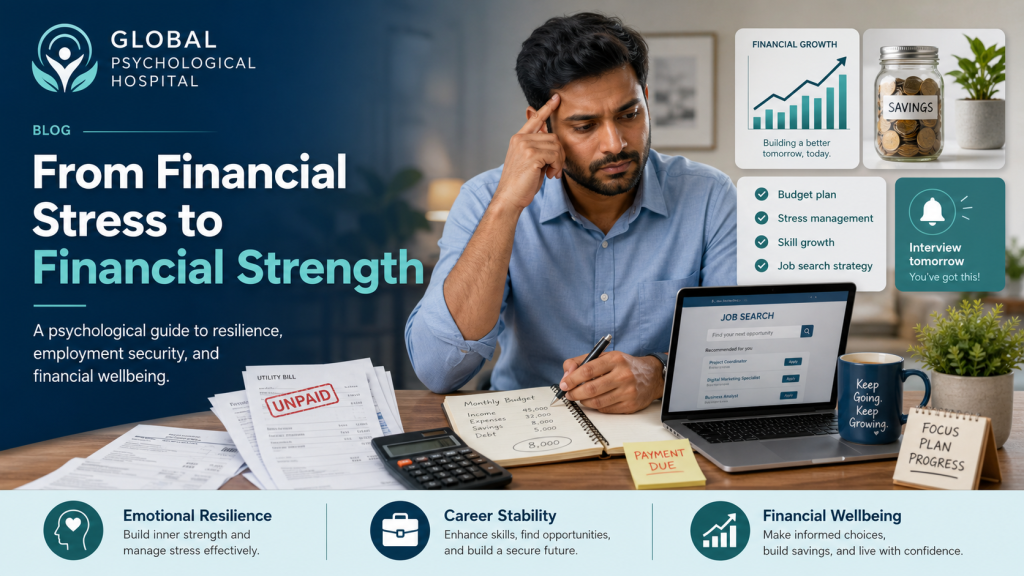
Financial stress is one of the most common psychological challenges faced by adults in today’s world. Rising living costs, unemployment, debt, unstable income, family responsibilities, educational expenses, and uncertainty about the future can create continuous mental pressure. For many people, financial stress does not remain limited to money matters; it begins to affect sleep, mood, confidence, decision-making, relationships, work performance, and overall quality of life.
At Global Psychological Hospital, we understand that financial stress is not only an economic issue. It is also a mental health concern. When a person feels financially insecure, the brain may respond with anxiety, fear, overthinking, avoidance, irritability, and emotional exhaustion. However, with the right psychological strategies, practical planning, and professional support, financial stress can be managed, employment confidence can be rebuilt, and financial wellbeing can be improved.
Why Financial Stress Affects Mental Health
Money is closely connected with security, dignity, family stability, personal identity, and future planning. When finances become uncertain, the mind may interpret the situation as a threat. This can activate the body’s stress response and make a person feel mentally and physically exhausted.
The American Psychological Association highlights that money and financial worries often remain among the leading sources of stress in adults’ lives. Financial concerns can affect people across different age groups, genders, and backgrounds.
Financial stress may also affect professional life. The World Health Organization states that job insecurity, excessive workloads, poor working environments, inequality, and low job control can increase mental health risks. WHO also reports that depression and anxiety lead to an estimated 12 billion lost working days every year, costing the global economy around US$1 trillion in lost productivity.
This shows that financial stress, employment insecurity, and mental health are deeply connected. A person cannot perform at their best when their mind is constantly occupied by fear, debt, unemployment, or financial uncertainty.
Common Signs of Financial Stress
Financial stress may appear differently from person to person. Some individuals become quiet and withdrawn, while others become angry, restless, or emotionally sensitive. Common signs include:
Difficulty sleeping due to money-related thoughts
Constant worry about bills, rent, loans, school fees, or family expenses
Feeling ashamed, guilty, or helpless about financial condition
Avoiding bank messages, payment reminders, or financial discussions
Loss of focus at work, study, or business
Reduced confidence after unemployment or financial loss
Frequent arguments with spouse or family members about money
Fear of the future and continuous overthinking
Lack of motivation to apply for jobs or improve skills
Emotional eating, excessive scrolling, smoking, isolation, or other unhealthy coping habits
If these signs continue for weeks or months, financial stress can increase the risk of anxiety, depression, burnout, relationship conflict, and poor decision-making.
Unemployment and Its Psychological Impact
Unemployment is not only the loss of income. It can also feel like a loss of routine, purpose, professional identity, confidence, and control. Many unemployed individuals begin to question their worth and ability. They may think:
“Maybe I am not capable.”
“My future is not secure.”
“I am becoming a burden.”
“Everyone else is progressing except me.”
“I will never recover financially.”
Research shows that unemployment is associated with higher levels of depression and anxiety, making it an important public health concern.
This is why unemployment should be handled with compassion, structure, and professional guidance. A person who is unemployed does not need blame or criticism. They need emotional support, practical direction, skill development, job-search discipline, and confidence rebuilding.
The Psychological Cycle of Financial Stress
Financial stress often creates a negative cycle:
Financial pressure → Anxiety → Avoidance → Poor decisions → Increased pressure
For example, a person may feel anxious about debt and avoid checking bills or payment reminders. Because the issue is avoided, deadlines pass, penalties increase, and the stress becomes even heavier.
Similarly, an unemployed person may feel rejected after several unsuccessful interviews. This can reduce confidence and motivation. As a result, the person may stop applying regularly, delay skill development, or avoid networking. This further reduces opportunities and increases hopelessness.
Breaking this cycle requires two important steps: emotional regulation and practical financial action.
How to Overcome Financial Stress Psychologically
1. Accept the Reality Without Self-Blame
The first step is to accept the situation without attacking yourself. Financial difficulty does not mean that you are a failure. Many capable and hardworking people face financial pressure due to inflation, job market changes, family responsibilities, business losses, health expenses, or unexpected life events.
Self-blame increases stress. Acceptance creates mental clarity.
Instead of saying, “I am ruined,” say, “I am facing a difficult financial phase, and I need a structured recovery plan.”
2. Convert Fear Into a Written Plan
Financial stress becomes more frightening when everything remains in the mind. Writing things down gives the brain a sense of control.
Prepare a simple written plan that includes:
Your monthly income
Your essential expenses
Your non-essential expenses
Your debts or pending payments
Your expected income sources
Your job or business opportunities
Your savings target
Your next 30-day action plan
A written plan reduces uncertainty and helps you make decisions based on facts rather than fear.
3. Separate Needs From Wants
During financial stress, it is important to distinguish between essential and non-essential expenses. Essential expenses may include food, rent, utilities, education, transport, healthcare, and necessary family responsibilities. Non-essential expenses may include luxury purchases, unnecessary subscriptions, excessive dining out, impulsive shopping, and status-based spending.
This does not mean life should become joyless. It means spending should become intentional.
Financial control begins when emotional spending is replaced with conscious spending.
4. Build Emotional Resilience
Emotional resilience means the ability to remain mentally stable during difficult situations. Financial stress becomes more manageable when a person learns to control panic, overthinking, and impulsive reactions.
Helpful psychological practices include:
Deep breathing during moments of panic
Daily journaling to organize thoughts
Prayer, reflection, or meditation for emotional grounding
Regular sleep routine
Physical movement or walking
Talking to a trusted person instead of suffering silently
Seeking professional counseling when stress becomes overwhelming
A calm mind makes better financial decisions than a frightened mind.
5. Protect Your Employment Through Skill Growth
In today’s economy, employment security depends not only on having a job but also on continuously improving your skills. A person who keeps learning becomes more adaptable and more valuable in the workplace.
To improve employment security:
Update your CV and professional profile
Learn one marketable skill every few months
Improve communication and digital skills
Build a professional network
Apply consistently instead of waiting for the “perfect” opportunity
Prepare properly for interviews
Seek feedback after rejection
Stay disciplined even when results are delayed
The World Health Organization emphasizes that decent work is good for mental health, while poor working conditions and job insecurity can harm mental wellbeing.
Employment is not only a source of income. It can also provide purpose, routine, identity, confidence, and social connection.
6. Create a Healthy Job Search Routine
For unemployed individuals, job searching should be treated like a structured daily routine. Without routine, unemployment can easily lead to overthinking, low confidence, and emotional fatigue.
A healthy job search routine may include:
One hour for job applications
One hour for skill development
Thirty minutes for CV improvement or interview preparation
Thirty minutes for professional networking
Daily physical activity
A fixed sleep and wake-up time
Limited social media use during productive hours
This structure helps the mind stay active and hopeful.
7. Manage Debt Without Panic
Debt can create heavy psychological pressure. However, panic does not solve debt. A clear repayment strategy does.
Start by listing all debts with amounts, due dates, and priority levels. Then contact lenders or concerned parties where possible and request a realistic payment arrangement. Avoid hiding from the problem. Avoid taking new debt to cover unnecessary expenses.
A debt plan should be realistic, not emotional. Even small consistent payments can rebuild confidence and reduce fear.
8. Build Savings Gradually
Many people avoid saving because they think the amount is too small. However, the habit of saving is more important than the amount at the beginning.
Start with a small percentage of income, even if it is modest. The purpose is to train the brain to create financial discipline. Over time, increase the savings amount as income improves.
Savings provide psychological safety. Even a small emergency fund can reduce fear and improve confidence.
9. Avoid Social Comparison
Social media often creates unrealistic financial comparison. People compare their real life with someone else’s edited lifestyle. This can increase dissatisfaction, shame, and impulsive spending.
Remember: financial wellbeing is not about looking rich. It is about being stable, peaceful, responsible, and future-focused.
A person with a modest lifestyle and strong financial discipline may be more secure than someone who appears successful but is under heavy debt and emotional pressure.
10. Seek Professional Psychological Support
If financial stress is affecting your sleep, mood, relationships, confidence, work performance, or ability to function, professional psychological support can be very helpful.
A psychologist can help you:
Understand the emotional impact of financial stress
Reduce anxiety and overthinking
Break avoidance patterns
Improve motivation and confidence
Develop problem-solving skills
Manage unemployment-related distress
Rebuild daily routine and discipline
Improve decision-making under pressure
At Global Psychological Hospital, our approach is compassionate, structured, and evidence-informed. We help individuals understand the psychological roots of financial stress and develop practical strategies for emotional stability, employment confidence, and financial wellbeing.
How Financial Wellbeing Supports Mental Wellbeing
Financial wellbeing does not mean having unlimited wealth. It means having a healthier relationship with money, better control over decisions, realistic planning, and confidence about the future.
Financial wellbeing includes:
Living within your means
Managing debt responsibly
Building emergency savings
Improving income skills
Making informed financial decisions
Reducing impulsive spending
Planning for future goals
Maintaining emotional balance during financial pressure
Research has shown that financial worries are associated with psychological distress, which means improving financial control can also support better mental wellbeing.
When a person becomes financially organized, the mind begins to feel safer. When the mind feels safer, decision-making improves. When decision-making improves, financial outcomes can also become better.
Final Message
Financial stress can feel overwhelming, but it does not have to define your future. Unemployment, debt, income instability, and financial pressure are serious challenges, but they can be managed with the right mindset, emotional support, practical planning, and consistent action.
You are not weak because you are financially stressed.
You are not a failure because you are unemployed.
You are not hopeless because you are struggling.
With psychological resilience, structured planning, skill development, and professional support, you can move from financial stress to financial strength.
Global Psychological Hospital is here to support you in building emotional resilience, career stability, and financial wellbeing.
Call to Action
Are financial worries affecting your sleep, confidence, relationships, or work performance?
Book a confidential consultation with Global Psychological Hospital and take the first step toward emotional stability, employment confidence, and financial wellbeing.
Very Good information thank you keep posting.