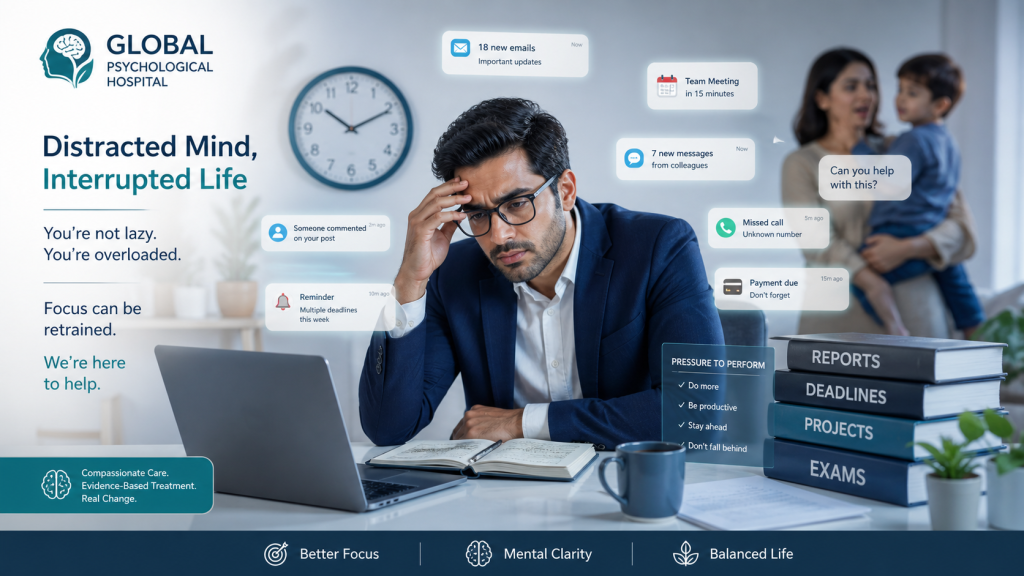

You are not lazy — your mind may be overloaded.
In today’s fast-moving world, many adults silently struggle with a common problem: they sit down to complete an important task, but within minutes their attention breaks. A phone notification appears, a social media app pulls them in, a family responsibility interrupts them, or the pressure of work and education becomes so heavy that the brain starts avoiding the task completely.
This is not always a weakness of character. In many cases, it is a sign of mental overload, digital distraction, stress, anxiety, poor routine, emotional pressure, or burnout.
At Global Psychological Hospital, we believe that focus is not just a productivity skill. It is also a mental health issue. When the mind is tired, overstimulated, or emotionally burdened, even simple tasks can feel difficult.
Why Focus Has Become So Difficult for Adults
Modern life is full of attention traps. Smartphones, social media platforms, online videos, work emails, family expectations, financial pressure, academic deadlines, and social comparison all compete for the same limited mental energy.
Research shows that digital devices and internet use have changed the way people manage attention. Psychologist Gloria Mark, PhD, has discussed how frequent digital interruptions and multitasking can increase stress and reduce the ability to stay focused for longer periods.
This means many adults are not failing because they do not care. They are struggling because their brain is being repeatedly pulled away from deep work, study, prayer, family presence, and personal goals.
The Hidden Cost of Digital Distraction
Social media is one of the most common sources of distraction. It gives quick pleasure, instant updates, entertainment, and emotional escape. But over time, excessive scrolling can train the brain to seek fast stimulation instead of sustained attention.
A research review available through the National Institutes of Health explains that social media can become a major source of distraction and may interfere with successful task completion.
This is especially harmful for adults who already face pressure from work, exams, business responsibilities, parenting, relationships, or financial stress. Instead of completing important tasks, the person may keep shifting between apps, messages, videos, and unfinished work.
The result is a painful cycle:
Distraction → Delay → Guilt → Stress → Avoidance → More distraction
Over time, this cycle can reduce confidence and create the feeling that “I cannot complete anything.”
It Is Not Always Laziness — It May Be Mental Overload
Many people blame themselves by saying:
“I am lazy.”
“I have no discipline.”
“I waste too much time.”
“I always start but never finish.”
“I cannot focus like other people.”
But the real issue may be deeper. Poor focus can be linked with anxiety, depression, chronic stress, burnout, sleep problems, emotional conflict, unresolved trauma, ADHD-like symptoms, or lifestyle imbalance.
The World Health Organization highlights that mental health at work is important because work can support confidence and functioning, but unhealthy work conditions can also harm mental health.
When stress becomes constant, the brain may move into survival mode. In this state, it becomes harder to plan, concentrate, control impulses, and complete long tasks. The person may look “careless” from the outside, but internally they may be overwhelmed.
Common Signs That Distraction Is Becoming a Mental Health Concern
You may need professional support if you often experience:
Difficulty starting important tasks
Leaving work, study, or business tasks incomplete
Constant phone checking without real purpose
Feeling restless when away from social media
Avoiding responsibilities because they feel too heavy
Losing hours in scrolling, videos, gaming, or unnecessary chatting
Feeling guilty at night because the day was wasted
Poor sleep due to screen use or overthinking
Anxiety before deadlines
Reduced confidence and motivation
Irritability with family members
Feeling mentally tired even after rest
If these signs continue for weeks or months, it is better to take them seriously instead of ignoring them.
Work Pressure, Education Pressure, and Family Culture
For many adults, distraction is not only caused by technology. It is also caused by pressure.
A student may be worried about exams, family expectations, career uncertainty, and comparison with others.
A working adult may face deadlines, financial responsibilities, office pressure, and fear of failure.
A parent may be emotionally divided between work, children, spouse, home responsibilities, and personal health.
The American Psychological Association’s Stress in America research continues to show that adults experience multiple stressors that affect mental wellbeing.
In cultures where people are expected to manage family, education, career, finances, and social image all at once, the mind can become overloaded. When the brain has too many emotional tabs open, focus naturally becomes weak.
Why the Brain Escapes Into Distraction
Distraction often gives temporary relief. When a person feels pressure, the brain looks for something easy and pleasant. Social media, entertainment, random browsing, and chatting give quick dopamine-based reward. This reward makes the person feel better for a few minutes.
But after some time, the real task is still waiting. Then guilt increases. The person feels more stressed and again escapes into distraction.
This is why many adults say:
“I know what I have to do, but I still cannot do it.”
This is not only a time-management problem. It can be an emotional regulation problem.
How to Rebuild Focus in a Healthy Way
The good news is that focus can be improved. The brain can be retrained with the right psychological support, routine correction, emotional management, and behavioral strategies.
1. Start with small focus blocks
Do not expect your brain to focus for three hours immediately. Start with 20 to 25 minutes of focused work. Keep the phone away during this time. After that, take a short break.
2. Remove the easiest distractions
Keep your phone away from your working table. Turn off non-essential notifications. Avoid opening social media before starting important work.
3. Write only three priority tasks
A long task list can overwhelm the mind. Write only three important tasks for the day. Completing three meaningful tasks is better than planning twenty and completing none.
4. Understand your emotional trigger
Ask yourself:
“Why am I avoiding this task?”
Is it fear of failure?
Is it boredom?
Is it perfectionism?
Is it pressure from someone?
Is it lack of confidence?
Once the emotional reason is identified, treatment becomes easier.
5. Fix sleep and screen timing
Poor sleep directly affects attention, mood, memory, and decision-making. Avoid late-night scrolling and try to create a calming bedtime routine.
6. Seek professional help when needed
If distraction is affecting your education, job, business, marriage, parenting, or self-esteem, professional counseling can help identify the real cause and build a practical recovery plan.
When Should You Consult a Psychologist?
You should consider consulting a psychologist if your lack of focus is affecting your daily life, work performance, studies, relationships, emotional stability, or confidence.
A psychologist can help assess whether your distraction is related to stress, anxiety, depression, burnout, ADHD symptoms, trauma, poor habits, or lifestyle imbalance.
At Global Psychological Hospital, our goal is not to judge you. Our goal is to help you understand your mind, rebuild your focus, and regain control of your life with evidence-based psychological care.
Final Message
If you are unable to complete your work, wasting time in distractions, and feeling guilty every day, remember this:
You are not broken. You may be overloaded.
You are not lazy. Your mind may need support, structure, and healing.
Focus can be retrained. Mental clarity can be restored. Life can become balanced again.
Global Psychological Hospital is here to help you move from distraction to direction, from pressure to peace, and from mental overload to meaningful progress.
Call to Action
Struggling with focus, stress, procrastination, or digital distraction?
Book a confidential consultation with Global Psychological Hospital and take the first step toward better focus, emotional balance, and mental clarity.