
Introduction
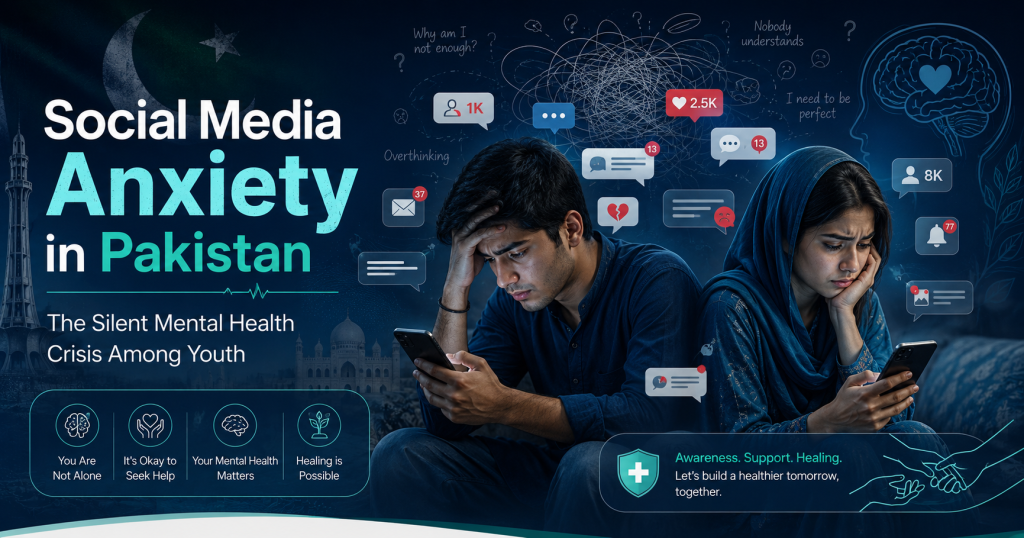
Social media has become a powerful part of modern life. It connects people, builds communities, supports businesses, spreads knowledge, and gives young people a platform to express themselves. However, behind the attractive posts, filtered photos, viral trends, and constant notifications, a silent mental health crisis is growing among Pakistani youth: social media anxiety.
In Pakistan, millions of young people use platforms such as TikTok, Instagram, Facebook, YouTube, Snapchat, and WhatsApp every day. DataReportal reported 79.9 million active social media user identities in Pakistan in late 2025, equal to about 31.2% of the population. It also reported that social media user identities in Pakistan increased by 16 million between late 2024 and late 2025.
This rapid digital growth has created opportunities, but it has also increased emotional pressure. Many young people now compare their lives with others, worry about likes and comments, fear being ignored, struggle with sleep, and feel anxious when they are away from their phones. For some, social media is no longer just entertainment; it has become a source of stress, insecurity, loneliness, and emotional disturbance.
At Global Psychological Hospital, we believe that understanding this issue is the first step toward healing.
What Is Social Media Anxiety?
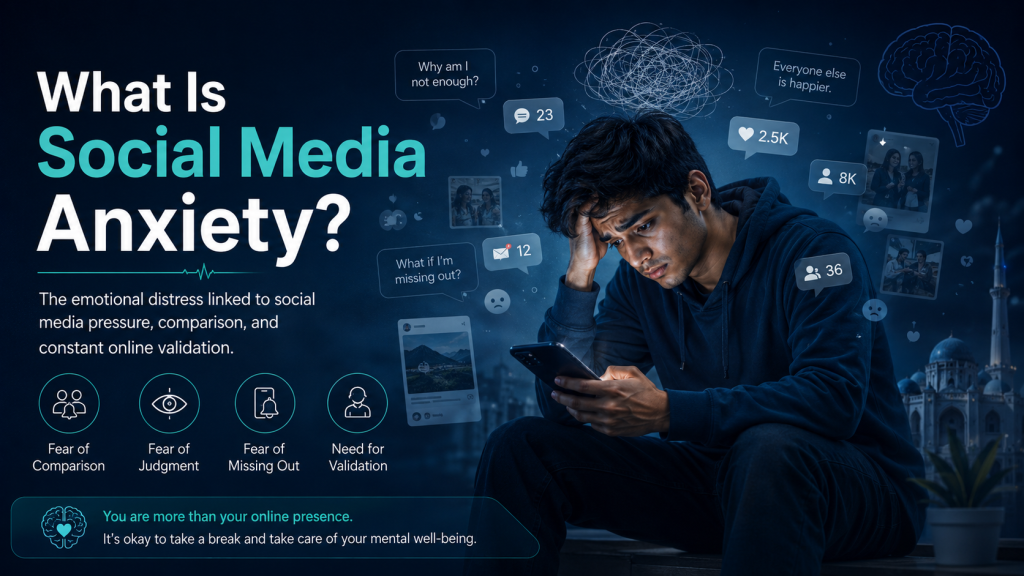
Social media anxiety is a form of emotional distress linked with the use of digital platforms. It may appear when a person feels nervous, insecure, restless, or emotionally disturbed because of online interactions, comparison, digital pressure, or fear of missing out.
A young person may feel anxious when:
They do not receive enough likes or comments.
Someone does not reply to their message.
They compare their life, appearance, success, or relationship with others.
They see luxury lifestyles and feel inferior.
They fear being judged, ignored, rejected, or exposed online.
They constantly check their phone for updates.
They feel uncomfortable when they are offline.
This anxiety may look simple from the outside, but for many young people, it becomes mentally exhausting.
Why This Issue Is Growing in Pakistan
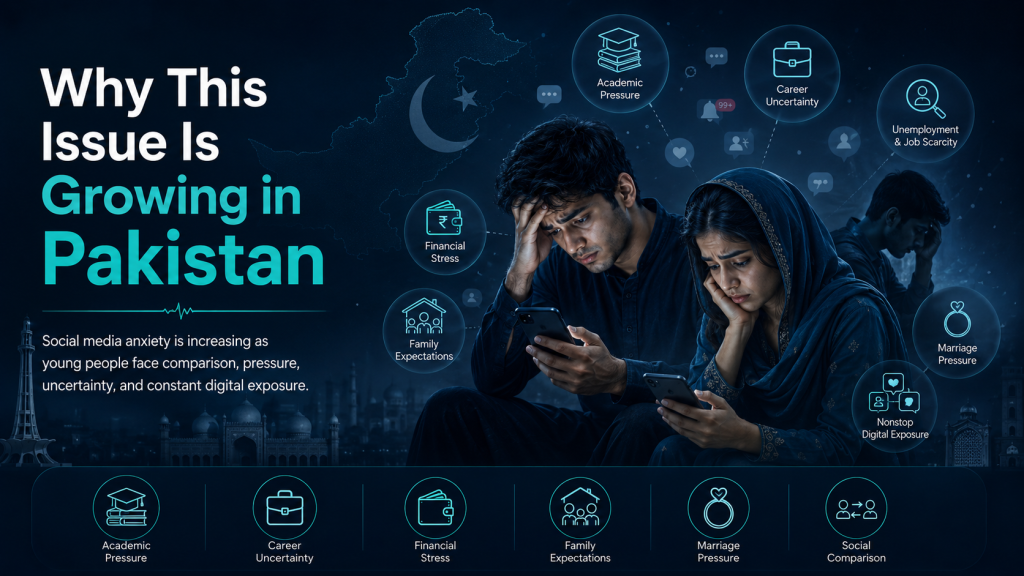
Pakistan has a young population, strong family expectations, rising academic pressure, increasing unemployment concerns, financial stress, relationship confusion, and social comparison. Social media has intensified all these pressures.
A student may compare academic achievements.
A young professional may compare income and career success.
An unmarried person may compare relationships and marriage status.
A young woman may compare beauty, body shape, lifestyle, and social acceptance.
A young man may compare wealth, confidence, status, and success.
Social media shows the best moments of people’s lives, but young users often compare those highlights with their real struggles. This creates a painful emotional gap between “what I am” and “what I think I should be.”
The problem is not only Pakistani. Globally, the World Health Organization has highlighted that emotional disorders are common among adolescents, and anxiety disorders are among the most prevalent mental health concerns in this age group. The issue becomes more serious when social media use starts affecting sleep, relationships, study, work, confidence, and emotional stability.
The Hidden Psychological Effects of Social Media
1. Constant Comparison
One of the biggest causes of social media anxiety is comparison. Young people compare their appearance, education, lifestyle, family status, relationships, income, travel, clothes, cars, and achievements.
The problem is that social media does not show full reality. It usually shows edited, selected, and polished moments. When young people compare their ordinary daily life with someone else’s best online moments, they may feel unsuccessful, unattractive, or left behind.
This comparison can slowly damage self-esteem.
2. Fear of Missing Out
Fear of missing out, commonly known as FOMO, is another common issue. Young people may feel that everyone else is enjoying life, attending events, building relationships, earning money, traveling, or becoming successful while they are stuck.
This fear can create restlessness, sadness, jealousy, and pressure to remain constantly online.
3. Sleep Disturbance
Many young people use mobile phones late at night. They scroll social media before sleeping, watch videos for hours, or remain engaged in chats. This affects sleep timing, sleep quality, and mental freshness.
Poor sleep can increase anxiety, irritability, lack of focus, low mood, and emotional weakness. When sleep is disturbed for weeks or months, it can contribute to serious mental health problems.
International research and public health guidance have increasingly raised concerns about the connection between heavy social media use, sleep problems, anxiety, and depression among adolescents and youth. The U.S. Surgeon General’s advisory noted that children and adolescents who spend more than three hours a day on social media may face double the risk of poor mental health outcomes, including symptoms of depression and anxiety.
4. Body Image Pressure
Social media often promotes unrealistic beauty standards. Filters, editing apps, luxury fashion, gym culture, cosmetic procedures, and influencer lifestyles can make young people feel dissatisfied with their appearance.
Many young women feel pressure to look perfect. Many young men feel pressure to look rich, muscular, confident, and successful. This can lead to low confidence, shame, insecurity, and emotional distress.
5. Online Rejection and Validation Addiction
For many youth, likes, comments, shares, and followers become a measure of self-worth. When their post performs well, they feel happy. When it does not, they feel ignored or rejected.
This creates a dangerous emotional dependency. A person’s confidence should not depend on an algorithm, but social media often trains the mind to seek approval from strangers.
6. Cyberbullying and Online Harassment
Cyberbullying is another serious concern. Negative comments, insults, fake accounts, blackmail, threats, character assassination, and online humiliation can deeply harm a young person’s mental health.
In Pakistan, many young people, especially girls, may suffer silently due to fear of family reaction, social stigma, or damage to reputation. This silence can increase anxiety, depression, panic, and trauma.
7. Reduced Real-Life Connection
Social media creates digital connection, but excessive use can reduce real-life emotional bonding. A young person may have hundreds of online contacts but still feel lonely, misunderstood, and unsupported.
Real healing often comes from meaningful human connection, family support, healthy friendships, counselling, and a balanced lifestyle.
Warning Signs of Social Media Anxiety
Parents, teachers, friends, and young people themselves should take the following signs seriously:
Persistent overthinking after using social media.
Feeling sad, jealous, angry, or inferior after scrolling.
Checking phone repeatedly without purpose.
Anxiety when unable to access the internet.
Poor sleep due to late-night phone use.
Loss of interest in study, work, or family interaction.
Low self-confidence because of online comparison.
Fear of posting due to judgment.
Emotional dependency on likes, comments, and followers.
Panic, crying, anger, or hopelessness after online conflict.
Avoiding real-life responsibilities because of excessive screen use.
Thoughts of self-harm or suicide.
When these symptoms continue and affect daily life, professional help should be considered immediately.
Why Pakistani Families Must Take This Seriously
In many Pakistani homes, mental health is still misunderstood. Anxiety may be called weakness. Depression may be ignored. A young person’s emotional pain may be dismissed as laziness, attitude, or overthinking.
This approach can make the problem worse.
Youth today are facing a different world. They are exposed to constant digital comparison, online judgment, academic competition, career uncertainty, financial stress, relationship pressure, and global lifestyle standards. Their emotional struggles are real.
Families should not shame young people for their distress. They should listen, understand, support, and guide them toward professional care when needed.
How Young People Can Protect Their Mental Health
1. Set Healthy Screen Boundaries
Do not allow social media to control your entire day. Set specific times for use. Avoid endless scrolling. Turn off unnecessary notifications.
A simple rule can help:
Use social media with purpose, not as an emotional escape.
2. Avoid Late-Night Scrolling
Keep your phone away at least 30 to 60 minutes before sleep. Replace scrolling with reading, prayer, journaling, deep breathing, or peaceful conversation.
Good sleep is one of the strongest foundations of mental health.
3. Stop Comparing Your Real Life with Online Highlights
Remember that social media is not full reality. People usually share success, beauty, happiness, and luxury. They rarely show failure, debt, sadness, family problems, insecurity, or loneliness.
Your journey is different. Your value is not measured by someone else’s timeline.
4. Follow Content That Improves Your Mind
Unfollow pages that make you feel inferior, angry, hopeless, or insecure. Follow educational, spiritual, motivational, mental health, skill-based, and positive content.
Your digital environment affects your emotional environment.
5. Build Offline Confidence
Spend time in real activities: exercise, study, skills development, family time, sports, religious practices, volunteering, and face-to-face friendships.
A healthy offline life reduces unhealthy online dependency.
6. Talk to Someone You Trust
If social media is making you anxious, depressed, angry, or hopeless, talk to a trusted friend, parent, teacher, mentor, or mental health professional.
Silence increases suffering. Conversation begins healing.
7. Seek Professional Help When Needed
Professional counselling is not a weakness. It is a responsible step toward emotional health. A trained psychologist can help identify the root causes of anxiety, develop coping skills, improve self-esteem, manage digital addiction, and restore mental balance.
Role of Global Psychological Hospital
Global Psychological Hospital is committed to supporting individuals, families, students, professionals, and youth facing emotional and psychological difficulties.
Our mental health services may help with:
Social media anxiety
Depression
Overthinking
Panic attacks
Low self-esteem
Sleep disturbance
Relationship stress
Academic pressure
Family stress
Anger and emotional instability
Digital addiction
Youth counselling
Parental guidance
Psychological assessment
Individual therapy
Online consultation
Our goal is to create a safe, confidential, and professional environment where people can speak openly, heal emotionally, and rebuild their confidence.
A Message for Pakistani Youth
You are not behind in life.
You are not a failure because someone else looks successful online.
You are not unattractive because filtered images appear perfect.
You are not weak because you feel anxious.
You are not alone because your pain is invisible.
Social media may show you thousands of lives, but it should not make you hate your own.
Your mental health matters. Your peace matters. Your future matters. With the right support, guidance, and treatment, anxiety can be managed, confidence can be rebuilt, and life can become meaningful again.
Conclusion
Social media anxiety is one of the silent mental health challenges of modern Pakistan. It affects students, young professionals, unmarried youth, influencers, job seekers, and even children. It damages sleep, confidence, concentration, relationships, and emotional wellbeing.
The solution is not to completely reject technology. The solution is to use it wisely, consciously, and with emotional discipline.
Families, schools, universities, workplaces, and healthcare organizations must work together to create awareness about digital wellbeing and mental health. Most importantly, young people must know that help is available.
At Global Psychological Hospital, we believe that mental health care should be accessible, respectful, confidential, and stigma-free.
Your mind deserves care. Your peace deserves protection. Your life deserves healing.
Call to Action
Are you or someone in your family struggling with anxiety, overthinking, depression, sleep problems, emotional stress, or social media pressure?
Contact Global Psychological Hospital today for professional counselling, psychological assessment, and confidential mental health support.
Early support can prevent deeper emotional suffering.